
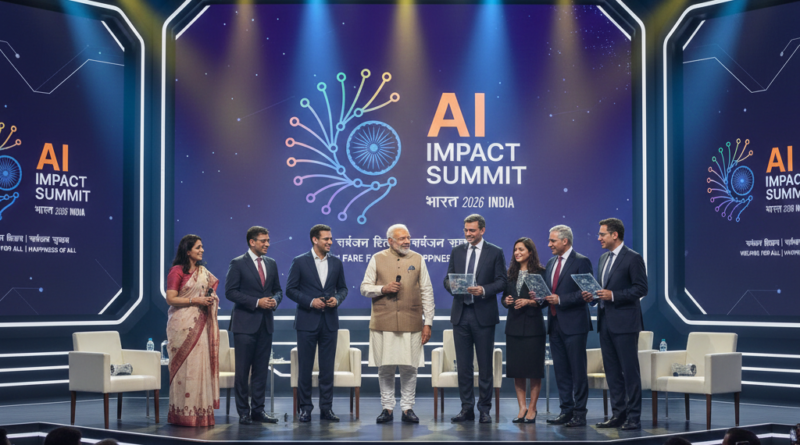
AI is Here: What the India AI Summit 2026 Means for Your Career
If you’re trying to figure out your career right now, the India AI Impact Summit 2026 just changed the conversation.
From February 16-21, New Delhi hosted over 3 lakh participants from 100+ countries—tech leaders from Nvidia, Google, OpenAI, plus government ministers—all discussing how AI is reshaping everything, including the job you’re preparing for.
India is Building AI, Not Just Using It
Indian companies launched major AI models at the summit—Sarvam AI released models with 30 billion and 105 billion parameters, Gnani.ai unveiled voice cloning in 12 Indian languages, and the government-backed BharatGen Param2 now supports 22 Indian languages.
The government allocated over ₹10,300 crore under IndiaAI Mission and expanded GPU capacity to 58,000 units at subsidized rates of just ₹65/hour. That means students in Patna or Ranchi can now access computing power previously available only to big companies.
Sounds promising. But there’s another side.
The Reality: Jobs Are Changing Fast
India’s Nifty IT index fell nearly 19% during the summit, wiping out approximately ₹4.8-5 lakh crore in market value. TCS cut about 12,200 jobs in July 2025. Major IT firms froze campus hiring.
Here’s what hits hardest: India produces 1.5 million engineering graduates annually. In 2024-25, major software companies hired only 70,000 to 80,000 fresh engineers—the lowest in two decades. Fewer than 1 in 10 engineering graduates will land IT jobs this year.
1 in 10. If you’re finishing B.Tech or MCA, this is your reality.
The IMF warned that 40% of jobs globally will be affected by AI. “Affected” doesn’t mean eliminated—it means changed. And change requires adaptation.
The Opportunities Are Real Too
AI-related job postings in South Asia rose from 2.9% to 6.5% between January 2023 and March 2025, with demand for AI skills growing 75% faster than non-AI roles.
New categories are emerging:
- AI deployment and governance
- Cybersecurity for AI systems
- Data interpretation and model supervision
- AI integration in healthcare, agriculture, manufacturing
If you’re in non-IT fields, domain expertise + AI literacy becomes your edge.
27 IndiaAI Labs established in tier-2 and tier-3 cities, with 174 more approved across 27 states. Google announced AI Professional Certificate programs, Microsoft committed to skilling 20 million Indians by 2030.
Access is becoming more democratic. You don’t need to be in Bangalore anymore.
What Government is Doing
India’s AI strategy has three layers: “Skilling in AI” (foundational competencies), “Skilling with AI” (AI-powered learning), and “Skilling for AI” (working alongside AI systems) .
1.34 lakh students enrolled under SOAR program. FutureSkills Prime registered 25.3 lakh learners across 3,000+ courses.
Ministers emphasized AI must augment human capability, not displace it. Tools demonstrated for farmers, electricians, construction workers, and weavers.
The scale is there. The question is execution.
The Hard Truth
The rhetoric of reskilling is compelling, but execution is arduous. Can the state and private sector build training ecosystems that keep pace with AI’s speed?
Millions of India’s youth risk becoming the “precariat”—a class vulnerable to exploitation with little hope of permanent jobs.
Experts urged creating a “displacement map—sector by sector, region by region—paired with a five-year skilling blueprint and employment shock absorbers”. We don’t have that clarity yet.
What You Should Do
If you’re in IT:
- Traditional coding jobs are shrinking—AI-related roles are growing
- Your degree isn’t enough—continuous learning is the baseline
- Competition is brutal—you need to stand out
If you’re in non-IT:
- AI is coming to your sector too
- Learn enough AI to integrate it into your field
- Use free resources, government programs—don’t wait for college
If you’re entrepreneurial:
- AI lowers barriers in content, data analysis, services
- Solve local problems—national solutions are crowded
- Access to resources is better than before
Bottom Line
AI leadership won’t be defined by who builds the biggest model—it will be defined by who builds the most capable workforce to deploy it responsibly.
AI will not eliminate work, but change it. Automation will decrease demand for repetitive jobs but increase demand for higher-order skills like model supervision, system integration, and data interpretation.
The students who adapt—who learn continuously, combine domain knowledge with AI fluency, and solve real problems—will do fine.
The ones who don’t? That’s the harder conversation.
The future is being built now. Are you building with it, or watching it happen?
The future is being built right now. The question is: are you building with it, or watching it happen?
For more stories on growth, development, and opportunities from across India, keep following BiharTouch.